Product
Your apps, your infrastructure.
ricochet integrates with your identity provider so your content remains secure. Incoming traffic is routed and apps scale intelligently based on demand.
How ricochet works
At its core, ricochet is a web server and application proxy. Built from the ground up in Rust for memory efficiency, a zero-dependency binary, and performance at scale.
Authentication
Verify access via your OIDC-compliant identity provider.
App proxy
Each app is load balanced behind a persistent and customizable URL.
Backend engine
Spawns the language runtime for each app on the host, in Kubernetes, or a container.
Access, activity, and telemetry
Identity comes from your provider, and ricochet stores authorisation, not passwords. Every action is logged, and every metric is yours to export.
Single sign-on
Bring any OIDC-compliant identity provider.
Scoped API keys
Keys carry explicit scopes and can be limited to named content.
Encrypted secrets
Environment variables are AES-256 encrypted at rest and decrypted into the process at start.
Audit logging
Deployments, changes and deletions are written to both file and database.
Telemetry
Built on OpenTelemetry, so metrics and traces plug into Grafana, Jaeger, Datadog, or whatever you already run.
Choose your engine
ricochet supports your infrastructure and your architecture at no additional cost, across three engines: your host Linux machine, a Kubernetes cluster, or containerized deployments in Docker or Podman.
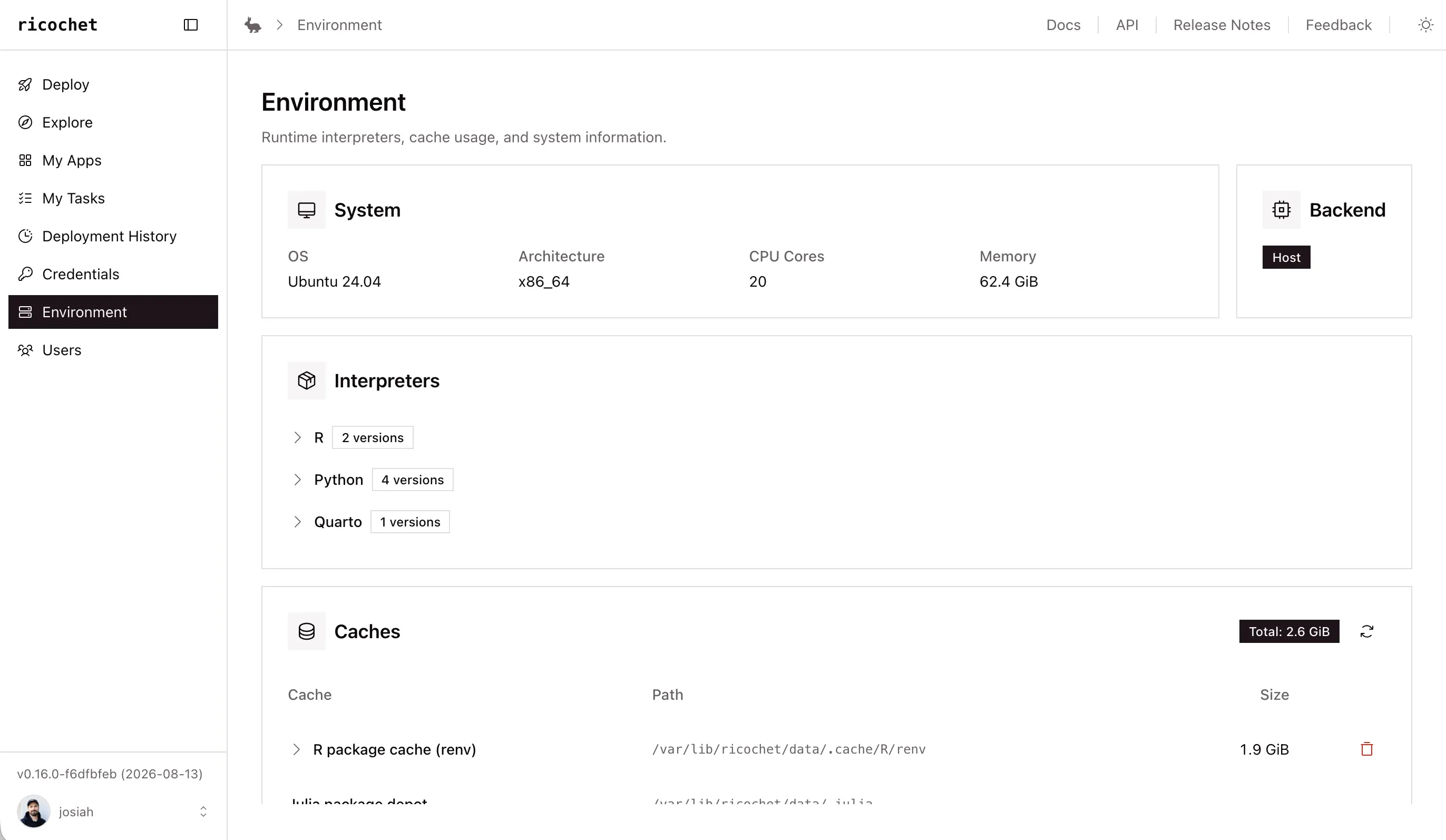
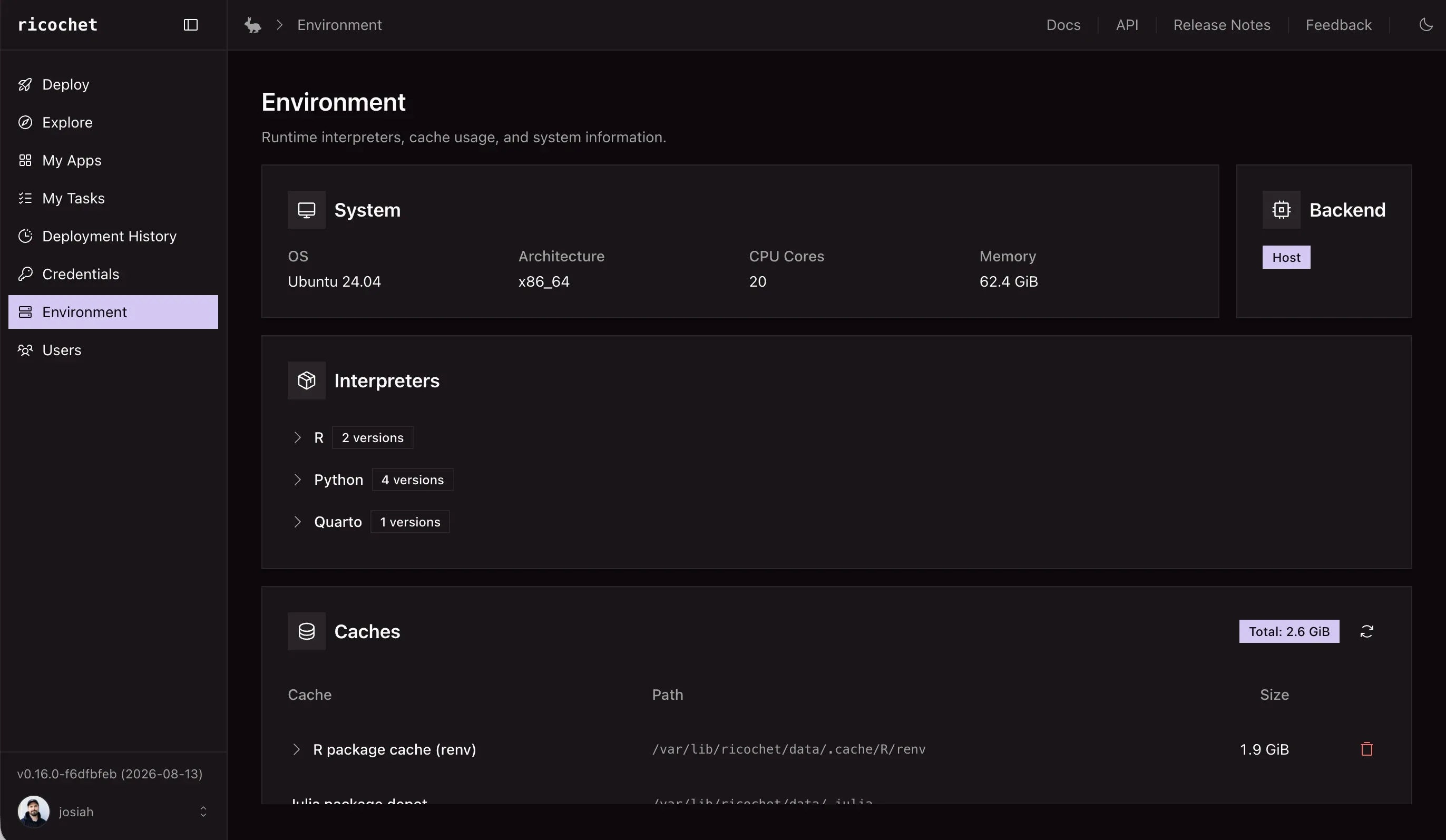
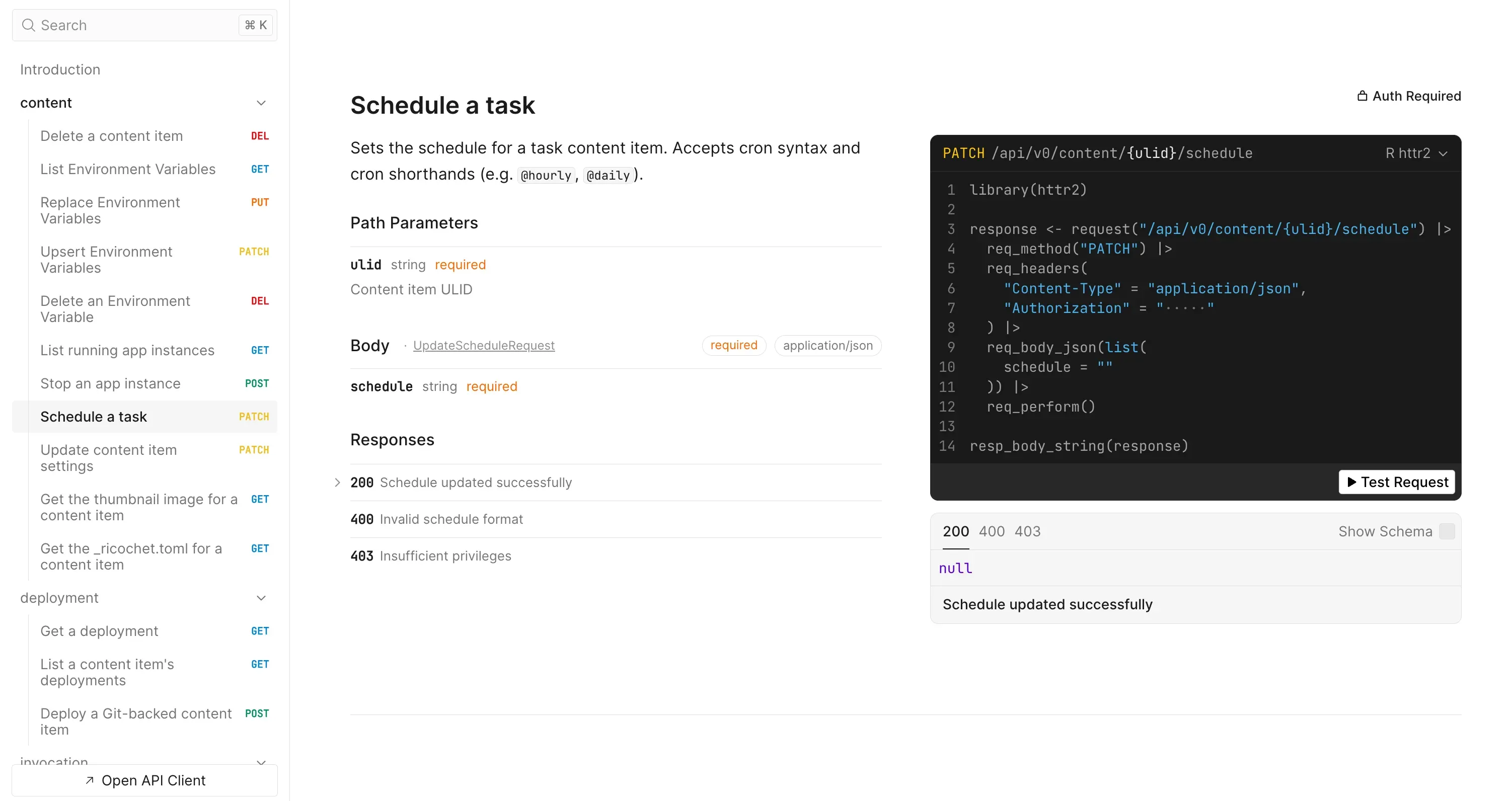
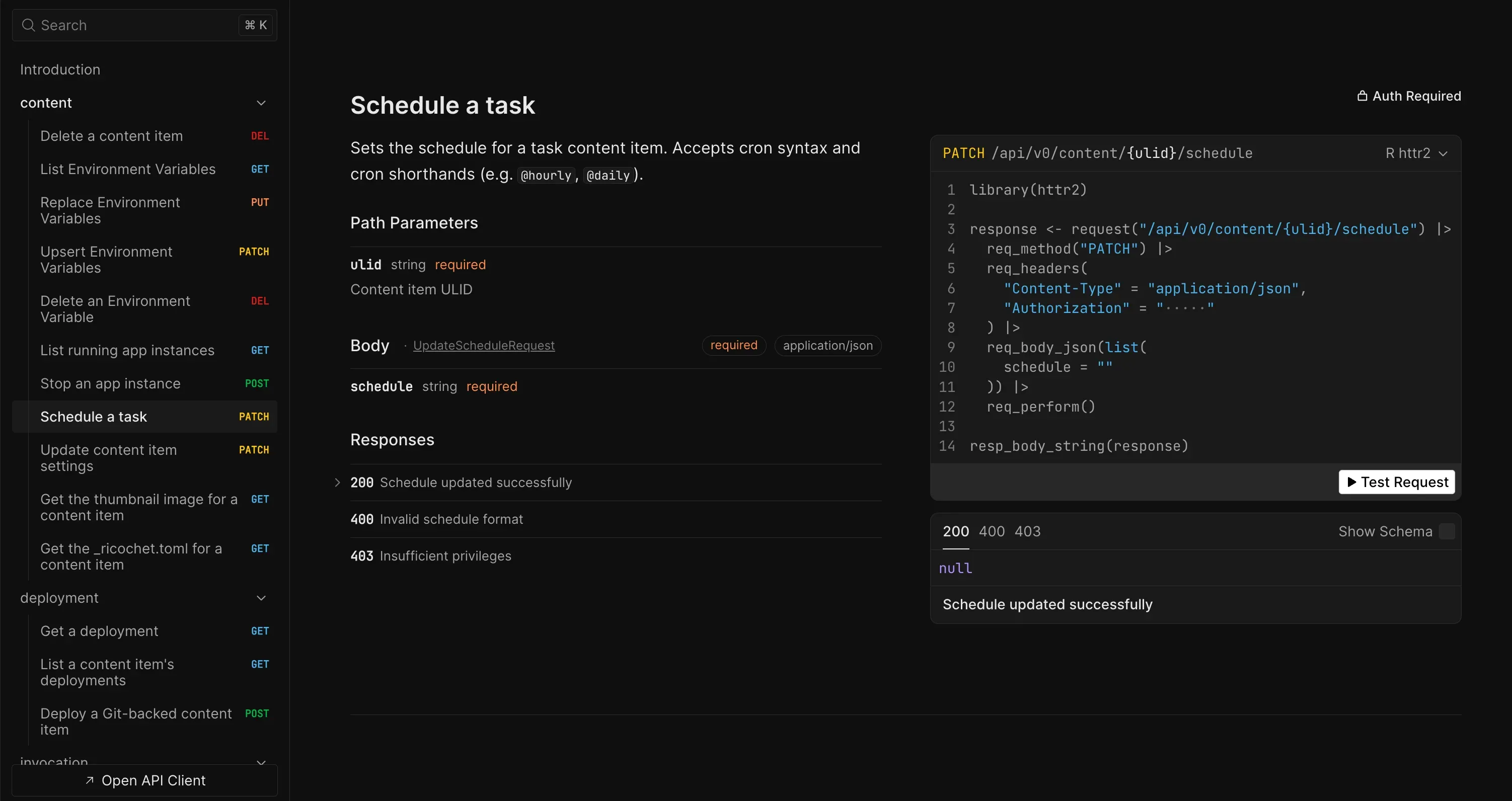
Everything the UI does, the API does too
Our CLI is built on that same API and installs on macOS, Linux and Windows. The reference is powered by Scalar, so every endpoint comes with a ready-to-use snippet in your language.
Isolated reproducible environments
Reproducibility and security is paramount. Every app runs in a rootless and isolated runtime with a standalone package evironment.
Pinned dependencies
Package and language versions are pinned to ensure reproducibility.
Lockfiles as environments
renv.lock, uv.lock and Manifest.toml define app-level environments.
Deployed from Git
Connect a repository and a branch, and ricochet pulls and redeploys itself.
Get started and read the docs
The docs cover installation, the content model, backend engine configuration and the CLI in full.